Put on the hat of a reductionist, and something becomes clear: it’s all just moving stuff out here.
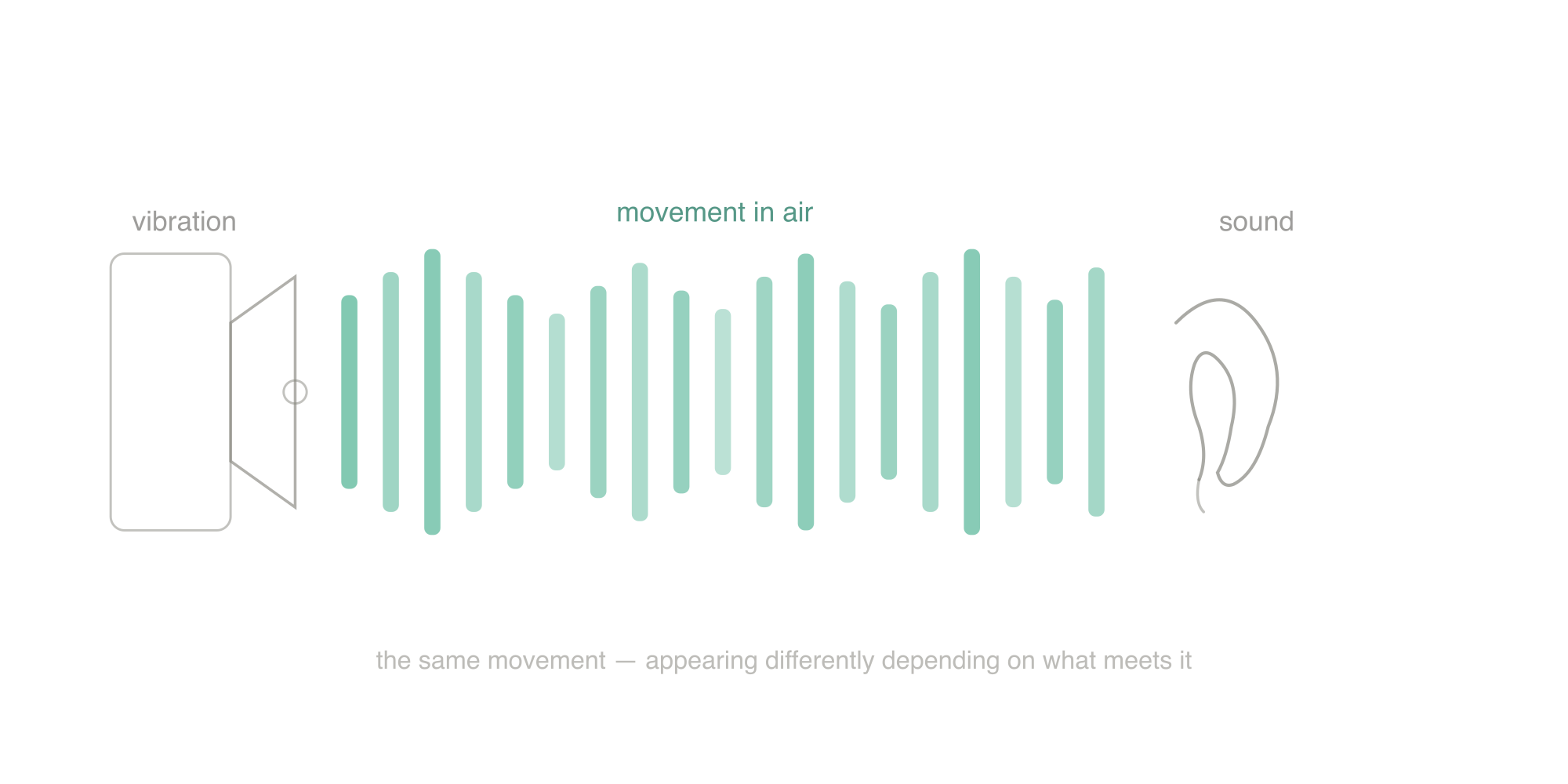
I noticed this at the gym. The workout music playing on the JBL speakers showed up not just as sound, but as vibration under my palms on the chair. Sound is essentially movement. Ears are what make certain movement appear as audio.
Right now, as I sit and type this, the ceiling fan hums above me and I can both hear it and feel it on my skin. The skin makes movement appear as touch. The eye makes another kind of movement appear as colour and form. The nose, as smell. The tongue, as taste. Movement in the nerves appears as thought. And movement within the body, woven together with thought, appears as emotion.
It’s all moving stuff and it shows up as sight, sound, taste, touch, smell, thought and feeling. All a representation of the movement, but not the thing in itself.
Like all movement, these have a physics to them. One movement causes another.
Somewhere along the way, we started drawing a boundary within this field of movement, calling what happens inside an arbitrarily chosen boundary as “me” and everything outside “not me.” But if that distinction is released, the whole thing appears as one movement.
Look at conversation. Movement in the nerves of one person leads to movement in the mouth and tongue … speaking. That creates movement in the air. That creates movement in the nerves and body of another … listening, feeling. Without a drawn boundary, the whole thing is just one unbroken causal flow in experience.
If the movement is one giant flow, it follows that the field in which it’s all experienced is also one. Habits of interpretation carve boundaries and produce the illusion of separation. But even after letting all of that go, one final duality seems to remain: moving stuff, and the experiencer of that movement.
Except “moving stuff” is how experience appears to itself. There isn’t stuff moving on one side and a witness on the other. Stuff cannot exist apart from experience. That’s the tell: what’s out here is only experience. When you draw a boundary inside experience and look at one side from the vantage point of the other, moving stuff appears. But that division was made by you – not found.
Consider coffee. The full experience of making and drinking a morning cup is one seamless whole. But the moment you start breaking it apart: hot water, coffee grounds, brown colour, ceramic weight, taste, the warmth spreading down your throat; you’ve stepped outside the experience and named its parts. Go further and you can describe it chemically, biologically, physiologically. Each lens produces a richer set of abstractions. But none of those abstractions were inside the experience. They were produced by standing outside it.
No one thinks by assembling nerve signals into sentences. No one dances by planning foot placements. Thought and dance happen as one unbroken movement. You can break them into steps, but that’s not how they actually occur in experience.
The ability to carve up a unified whole and examine each piece isn’t evidence that those pieces are real. At most, it’s evidence that a whole can appear as parts when looked at that way.
We’ve gotten into the habit of watching life by drawing lines – pegging a sense of self to one side and watching everything else from there. That’s not wrong. It’s even useful and, honestly, kind of fun. But what appears across those lines isn’t what’s actually there. It’s a representation. A dashboard of something far simpler.
What’s actually here is just experience in consciousness — watching itself from seemingly different vantage points, mistaking the view for a division.
Leave a Reply
You must be logged in to post a comment.